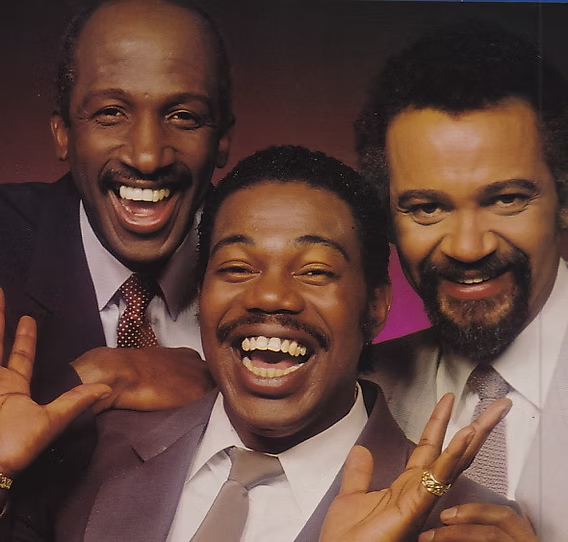
80s Snapshot:
- Number of songs on Hot 100: 1
- Highest peak position: 97
- Cumulative weeks on Hot 100: 3
Adding another genre to our musical diversity of the 80s, this will be our first foray into the infusion of jazz into contemporary pop and rock. This will also be our first time covering an artist who had a decades-spanning run of success on the Hot 100 (in fact, Jim Henson with 2 career entries is the only artist we’ve explored so far who had more than one lifetime Hot 100 entry).
The Jazz Crusaders were founded in Los Angeles in the early 1960s with the quartet of Joe Sample (piano), Wilton Felder (saxophone), Stix Hooper (drums) and Wayne Henderson (trombone) accompanied by a rotating stable of bass players. As the name suggested, they cut their teeth making straight-up instrumental jazz records, specializing in the hard bop variety. Their output was rather prolific, pumping out 12 albums on the Pacific Jazz label (9 studio, 3 live) between 1961 and 1966.
It was that 9th studio album, 1966’s Talk That Talk, which provided their first crossover into the mainstream. While previous albums had occasionally featured covers (mostly of classical pieces or standards), this album featured 4 covers of songs that had been Top-10 Billboard hits within the past 3 years. This included the album’s lone single “Uptight (Everything’s Alright)”, a cover of Stevie Wonder’s smash hit from earlier that year. It spent a week on the Hot 100 at #95 in the group’s maiden voyage on the Billboard charts.
The group released 6 more albums as The Jazz Crusaders, culminating in 1970’s Old Socks New Shoes – New Socks Old Shoes, their first effort to crack the Top 100 on the Billboard albums chart. The final track on that album, “Way Back Home” was released as a single and made #90 on the Hot 100 in January 1971. Shortly thereafter, their name was shortened to just The Crusaders, hinting at their aspirations to not be pigeon-holed into the limited commercial confines of a straight jazz group.
A large part of this transformation was bringing famed session guitarist Larry Carlton (who will have his own post later in this journey) into the group. Their first album with Carlton, 1972’s Crusaders 1, featured the single “Put It Where You Want It” which was emblematic of the group’s new jazz-funk fusion sound and reached #52 on the Hot 100. Under this membership, the group also made the Hot 100 two additional times with “Don’t Let It Get You Down” (#86 in 1973) and the live recording “Scratch” (#81 in 1974). This lineup of the Crusaders earned 4 Grammy nominations for Best Instrumental R&B performance.
The Crusaders’ sound made another drastic change in the late 70s: original member Wayne Henderson left after 1976’s Those Southern Knights and Carlton departed after 1977’s Free As The Wind. Now down to a trio of Sample, Felder and Hooper, the Crusaders began to look to the dominant style of the day – disco – as the next genre to infuse with their jazz sensibilities. Their first album as a trio, 1978’s Images, earned the group its 5th Grammy nomination for Best Instrumental R&B Performance. In addition to the change in sound, they also incorporated vocals for the first time, recruiting up-and-coming singer Randy Crawford to lend her voice to the title track of their 1979 album Street Life. The single became a sizable hit, peaking at #36 on the Hot 100 to become the group’s first and only Top 40 single. “Street Life” also made the Top 5 on the UK charts, launching a successful career for Crawford across the pond.
The Crusaders tried the formula of rented vocals again in 1980 by recruiting Bill Withers to sing on their single “Soul Shadows”, but it failed to crack the Hot 100. A more successful attempt came the following year with 1981’s album Standing Tall which featured Joe Cocker on two of its tracks, both of which were released as singles. The first of those, the triumphant and piano-heavy “I’m So Glad I’m Standing Here Today”, briefly cracked the Hot 100, debuting at #98 on the 9/27/1981 chart and spending the following two weeks at a #97 peak.
“I’m So Glad I’m Standing Here Today” was nominated for Best Inspirational Performance at the 24th Grammy Awards (losing to B.J. Thomas), with the Crusaders and Cocker performing the song at the ceremony in a gospel-themed segment. The performance received a rousing ovation and put Cocker back in the public eye for the first time in several years; his career would undergo a sizable renaissance in the years that followed (we won’t see his entry in this journey for quite some time).
As for The Crusaders, they earned further Grammy nominations for their 1982 live performance of “Street Life” with B.B. King and the Royal Philharmonic Orchestra, as well as their 1984 album Ghetto Blaster (their first after Stix Hooper left the group). For the next two decades, the group existed as an amorphous mixture of members from the band’s golden period, with the initial quartet and Carlton all making appearances here and there under both the Crusaders and Jazz Crusaders name. Their 2003 album Rural Renewal featured Sample, Felder and Hooper (plus guest appearances on guitar by Eric Clapton and Ray Parker Jr.) and earned the group their 9th and final Grammy nomination. Sample, Felder and Henderson each passed away within 18 months of each other between 2014 and 2015. As of 2025, Hooper remains a prolific figure in the jazz community, releasing his most recent recording Orchestrally Speaking in 2022.
Next: B.J. Thomas
Previous: Jay Black
 Every 80s Artist: A Ranked Journey
Leave a comment