80s Snapshot:
- Number of songs on Hot 100: 1
- Highest peak position: 94
- Cumulative weeks on Hot 100: 2
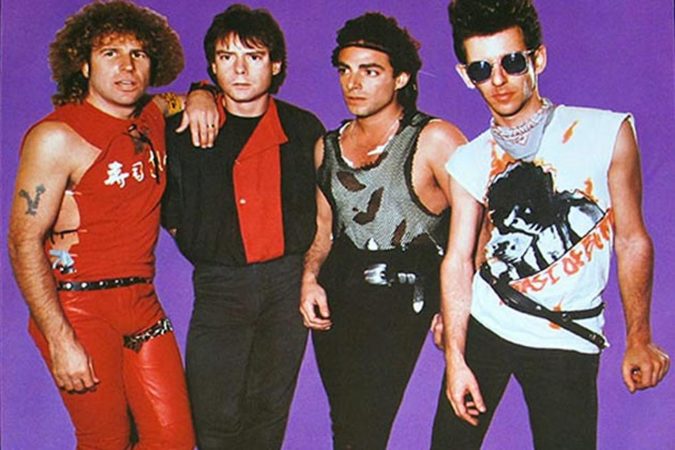
The concept of the supergroup long predates the 80s and it continued long after, but this decade was a particularly fertile time for them (especially in the rock space). The first of these that we will encounter, and certainly one of the least creatively-named, is the quartet Hagar Schon Aaronson Shrieve.
HAGAR:
Sammy Hagar, “The Red Rocker”, was in the midst of a slow but steady climb to stardom in 1983. After beginning his musical journey with the band Montrose in the mid-70s, he embarked on a solo career with his debut album Nine On A Ten Scale in 1976. The late 70s saw him scrape the lower reaches of the Hot 100 with songs like “You Make Me Crazy” and his cover of “(Sittin’ On) The Dock Of The Bay”, but his luck turned in the early 80s. After moving from Capitol Records to Geffen, Hagar’s pop-friendly hard rock sound began to hit it big, and he earned his first Top-40 hit in December 1982 with “Your Love Is Driving Me Crazy.”
SCHON:
Guitarist Neal Schon’s journey (pun intended) was on a different trajectory than Hagar’s, just starting to come down from its zenith. Schon first rose to fame as a member of Santana, joining the band at age 17 in 1971 and playing on two albums. After also playing on two albums of Santana splinter group Azteca, Schon became a founding member of Journey. The band released three moderately-successful albums but no hit singles with fellow Santana alum Gregg Rolie on lead vocals. Though Rolie remained with the band for several more albums, the band’s fortunes turned when they added Steve Perry as new lead vocalist. Each of their five albums released between 1978 and 1983 went at least 3x platinum, and spawned no fewer than 12 Top-40 singles in that timeframe.
Shortly after the release and success of Journey’s 1983 Frontiers album (featuring huge hits in “Separate Ways (Worlds Apart)” and “Faithfully”), Schon reached out to Hagar about the possibility of a short-term team-up. Initially, they began working with drummer Denny Carmassi, who had been in Montrose with Hagar and also played on two of his early solo albums. However, while the project was tabled during Journey’s massive tour supporting Frontiers, Carmassi wound up joining the band Heart. Hagar and Schon re-convened in fall 1983 and recruited a bassist and drummer to round out their lineup.
AARONSON:
Kenny Aaronson rose to prominence as the bassist in the short-lived hard rock group Dust in the early 70s, before joining the band Stories. His distinctive bass line helped take their song “Brother Louie” to the top of the Billboard Hot 100 in 1973, and he remained with the band for two albums. Aaronson then played on five Rick Derringer albums in the late 70s before joining the band Silver Condor for their second album in 1983. That album featured a guest appearance from Neal Schon and served as the introduction / recruitment process for Aaronson to join the fold.
SHRIEVE:
Drummer Michael Shrieve was much well-known to Schon. He had joined Santana two years before Schon and played on each of the band’s first six albums (including their performance at Woodstock). He spent most of the late 70s and early 80s as a hired-gun session drummer, before becoming a founding member of the rock group Novo Combo. That band had two songs from their 1981 self-titled album reach the Album Rock Tracks chart: “Up Periscope” (#43) and “Tattoo” (#42).
With the bassist and drummer now in place, Hagar Schon Aaronson Shrieve rehearsed together for only a month before taking to live performance (a two-week stint at San Francisco’s Warfield Theatre in November 1983). Rather than record in the studio, the band instead decided to use the recordings from those performances and edit out most of the crowd noise. The resulting product was their lone album Through The Fire.
Three of the songs from that album found their way onto the Album Rock Tracks chart. “Top Of The Rock” was the first to debut in late March 1984, ultimately reaching #15 on that chart; “Missing You” debuted two weeks later and peaked at #37. While their cover of Procol Harum’s “Whiter Shade Of Pale” was only moderately successful on AOR radio (making #30 on the Album Rock Tracks chart), its familiarity enabled it to be the quartet’s lone voyage on the Hot 100. It debuted at #95 on the 5/19/1984 chart, and climbed one spot to a peak of #94 in its second and final week on the chart.
Never intended to be a long-term engagement, the quartet went their separate ways after this brief endeavor. That same year, Hagar would record his signature solo hit “I Can’t Drive 55” (#26 on the Hot 100) and went on to replace David Lee Roth as the lead singer of Van Halen shortly thereafter. We will learn more about both his solo career and his time in Van Halen in future entries.
Schon continued to enjoy success with Journey, albeit slightly less than their early 80s peak. After 1986’s Raised On Radio, the band went on an extended hiatus and Schon would join Bad English, yet another supergroup, in Journey’s absence. While he never hit #1 on the Hot 100 while with Journey or Santana, Bad English’s “When I See You Smile” gave Schon his first chart-topper.
Aaronson and Shrieve maintained their status as hard-working session men throughout the 80s. Among Aaronson’s contributions were additional bass on two Blue Oyster Cult albums as well as Billy Idol’s Vital Idol remix album, and he was a member of Joan Jett and the Blackhearts in the mid-90s. Shrieve’s work varied greatly, ranging from Supertramp singer Roger Hodgson’s solo album In The Eye Of The Storm to jazz trumpter Freddie Hubbard’s Times Are Changing.
Next: Nick Jameson
Previous: Mica Paris
 Every 80s Artist: A Ranked Journey
Leave a comment