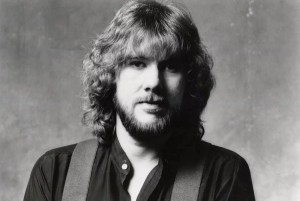
80s Snapshot:
- Number of songs on Hot 100: 1
- Highest peak position: 95
- Cumulative weeks on Hot 100: 3
Though best-known for a brief period of soft rock chart dominance, David Pack’s voice impacted the charts in four separate decades.
Pack is best known as the guitarist and lead vocalist for the band Ambrosia, which he co-founded in Los Angeles in 1970. A large portion of the band’s output (especially their album fare) falls under the progressive work umbrella, and they had a close working relationship with Alan Parsons, one of the biggest names in the genre. Their self-titled 1975 album was engineered by Parsons, while their sophomore album Somewhere I’ve Never Travelled was produced by Parsons.
In spite of that progressive rock sound that dominated their album tracks and blended with their pop sensibilities on their early hit singles, Ambrosia attained another level of stardom when they branched out with a softer sound in their late 70s singles. Pack wrote and sang lead vocals on the group’s biggest hits, most notably 1978’s “How Much I Feel” and 1980’s “Biggest Part Of Me”, both of which peaked at #3 on the Billboard Hot 100. Ambrosia ultimately charted 7 songs on the Hot 100 (including 5 Top-40 hits) before disbanding in 1982. Their career will be explored in more detail when their entry arrives much farther down the road.
Pack’s solo career began with the 1985 album Anywhere You Go, which much like Ambrosia’s work featured his songwriting on all 10 tracks. One of those tracks was “Prove Me Wrong”, a synth-heavy number alternates between a midtempo, gruff verse and a double-time chorus which calls to mind (and actually predates) Kenny Loggins’ “Danger Zone”. And much like the ubiquitous Loggins track, “Prove Me Wrong” was also tapped to feature on a movie soundtrack.
The soundtrack to the 1985 Gregory Hines / Mikhail Baryshnikov dance film White Nights featured contributions from many of the biggest names in pop music circa 1985. It is one of very few movie soundtracks which can claim not one, but two Hot 100 #1 hits: both Lionel Richie’s “Say You, Say Me” and the Phil Collins / Marilyn Martin duet “Separate Lives” reached the summit in late 1985. Pack’s “Prove Me Wrong” was tabbed as the next single from the soundtrack but failed to live up to the lofty precedent set by the previous two tracks. It debuted at #96 on the 1/25/1986 Hot 100, climbing a spot to #95 the following week, then dropping to #98 in its 3rd and final week on the Hot 100.
Leaning back into the soft rock feel that took his voice to the top of the charts, the other two singles from Anywhere You Go were more in line with the Ambrosia sound and earned airplay on adult contemporary radio. “That Girl Is Gone” reached #16 on the AC chart in the summer of 1986, and “I Just Can’t Let Go” (featuring fellow soft rock staples Michael McDonald and James Ingram) hit #13 on the AC chart in late fall. However, neither of these singles were able to crack the Hot 100.
That would be the extent of Pack’s solo recordings for almost two decades. Ambrosia reformed in 1989, and had some success on the Adult Contemporary chart in their own right in later years. Notably, their re-working of “I Just Can’t Let Go” made #26 on the AC chart in 1997, faring slightly worse than Pack’s original solo recording. Pack left the group for good in 2000, a few years before a remixed version of “Biggest Part Of Me” reached #31 on the AC chart in 2004.
Pack returned to solo recordings with a pair of albums in the mid-2000s, 2004’s Unborn and 2005’s The Secret Of Movin’ On. The title track of the latter album featured Heart’s Ann Wilson on backing vocals and received some easy listening airplay. “The Secret Of Movin’ On (Travelin’ Light)” wound up reaching #25 on the Adult Contemporary chart.
Pack has remained active in the music community in a variety of ways, ranging from continued vocal work with Alan Parsons to production work for a variety of acts as big as Aretha Franklin and Phil Collins. He was the producer and music director for both of Bill Clinton’s inaugurations, but to this author, his most impactful contribution to music was serving as the host for the Time-Life informercial “The Best Of Soft Rock”.
Next: Wayne Massey
Previous: Simon F
 Every 80s Artist: A Ranked Journey
Leave a comment