80s Snapshot:
- Number of songs on Hot 100: 1
- Highest peak position: 92
- Cumulative weeks on Hot 100: 2
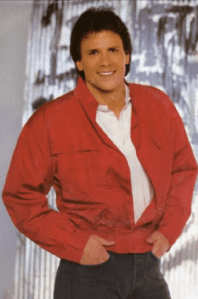
In a rarity among the stories we’ve examined so far, Wayne Massey’s is one where his lone career appearance on the Hot 100 represented the very beginning of his career in the public eye. In fact, up until 1980 when he was already in his 30s, Massey had never even partaken in the entertainment sector.
The closest Massey had come to fame had been as a teenager in the mid-60s when he was part of a group called The Bompers with some family members and a school friend. Their single “Do The Bomp” was a local hit in the Los Angeles area. Massey’s fame could easily have been in baseball, as he was drafted by the California Angels, but a severe car accident caused career-ending injuries and extensive rehab.
For the ensuing decade, Massey’s life did not seem like it would lend itself to the public eye. After serving for a number of years as a Mormon missionary and attending business school at BYU, by the end of the 70s he was a businessman only recreationally pursuing singing and acting.
But in 1979, he attended an audition for the ABC soap opera One Life To Live, at which he did not earn the role that was being cast. Rather, due to a combination of his looks, charisma, and singing voice, a brand-new role was created specifically for him. For the next five years, Massey would portray the country star Johnny Drummond on One Life To Live, and he quickly sought to make his personal music career match that of the character he portrayed.
Signed to Polydor Records, Massey’s debut single was aptly titled “One Life To Live” to cash in on his new fame, though it was not based on the show’s theme music. Rather, it was a country-pop ballad in the vein of the Kenny Rogers hits that were omnipresent in the early 1980s. Released in the fall of 1980, “One Life To Live” debuted at #93 on the 10/11/1980 Hot 100, and climbed to #92 in its second and final week on the chart. An album also titled One Life To Live was released shortly thereafter, but failed to reach either the pop or country album charts. The following year, Massey would marry his co-star Andrea Evans, capping an unbelievable two-year turn of events.
Though “One Life To Live” would be Massey’s only foray onto the pop charts, he was able to parlay his onscreen role into a modicum of country success. Part of his storyline on the show involved performing at the Grand Ole Opry, the most venerated venue in country music. While One Life To Live merely built a replica of the Opry stage (helped by a guest role from prolific Opry member Bill Anderson), Massey was given the honor of performing a few times at the real Opry in Nashville as a guest of Anderson’s weekly residence.
Across his run on the show, Massey put out a handful of country singles, three of which made their way onto the Billboard country chart. 1981’s “Diamonds and Teardrops” made #82, 1983’s “Lover in Disguise” hit #71, and 1983’s “Say You’ll Stay” peaked at #57. Though only moderate successes, the latter two singles helped him earn a nomination for Top New Male Vocalist at the 1984 ACM Awards. Massey’s run on One Life To Live ended in 1984, shortly after his marriage to Evans similarly dissolved.
His next chapter in country music began by chance after being cast in the music video for Charly McClain’s 1983 single “Fly Into Love”. McClain was a bona fide country star in her own right; by 1983, she had already charted 19 songs on the Billboard country chart, including a pair of Number Ones with 1980’s “Who’s Hurtin’ Who” and 1983’s “Paradise”. Massey and McClain married in 1984 and began working as a duo.
While McClain’s solo career continued apace (including another country #1 hit in 1985 with “Radio Heart”), she also worked on a collaborative album with Massey (1986’s When Love Is Right). As a husband-wife duo, Massey and McClain charted four singles on the Billboard country charts, including a pair of Top 10 hits in “With Just Look In Your Eyes” (#5) and “You Are My Music, You Are My Song” (#10).
Massey’s final forays in the recording industry came at the end of the 80s, when both he and McClain were signed to Mercury Records. He produced his wife’s final studio album, 1988’s Charly McClain, and released his second solo album, Wayne Massey and Black Hawk, in 1989. “Shoot The Moon” from the album made #81 on the country chart and became his final charting single. Though he departed the industry in the 90s, Wayne Massey’s rise to fame and commendable decade in country music is certainly one of the more improbable stories that we will encounter on this journey.
Next: Abstrac’
Previous: David Pack
 Every 80s Artist: A Ranked Journey
Leave a comment