80s Snapshot:
- Number of songs on Hot 100: 1
- Highest peak position: 90
- Cumulative weeks on Hot 100: 2
Reviving musical styles of yesteryear is a trend we will revisit numerous times across this journey through the 80s, whether it be from larger acts testing out a throwback style or acts building their whole sound and persona around the retro theme. Both types are at play in this installment, though the latter describes the group in question. But while many throwback acts of this era saw the rock and roll of the 50s or the Motown sound of the 60s as inspiration, Kid Creole and the Coconuts set their gaze several decades farther into the past.
The story of Kid Creole and the Coconuts begins in the mid-1970s with Dr. Buzzard’s Original Savannah Band, a New York City disco band whose unique sound incorporated elements of big band, swing and Latin genre influences into the more contemporary sounds. Regular performers at Studio 54 in its heyday, their self-titled 1976 album was certified gold and contained two singles which charted on the Hot 100: “I’ll Play The Fool” (peaked at #80) and the medley “Whispering/Cherchez La Femme/Se Si Bon” (#27). This success earned the band a nomination for Best New Artist at the 1977 Grammy Awards, which they lost to the Starland Vocal Band.
After diminishing returns on their second and third albums, the band split in 1979. Singer Cory Daye had a solo hit of her own that same year with “Pow Wow”, peaking at #76 on the Hot 100 in November. Lyricist August Darnell and vibraphonist/percussionist Andy Hernandez joined forces to create a spiritual successor to Dr. Buzzard’s Original Savannah Band.
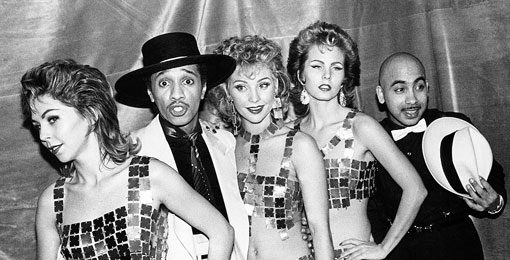
Taking inspiration from the Elvis Presley movie King Creole, Darnell assumed the moniker of “Kid Creole” and Hernandez adopted the persona of “Coati Mundi”. Backed with a trio of singers (among them Darnell’s then-wife Adriana Kaegi), Kid Creole and the Coconuts was born. With disco on the decline, they maintained the big band and Latin influences with the over-the-top Cab Calloway aesthetic/stage persona while leaning into the nascent sounds of hip-hop.
Their first album Off The Coast Of Me released in summer 1980 to little commercial success (a maxi-single medley of three of the songs scraped the Dance Club Songs chart at #53), but gained them enough local notice in New York to earn a coveted television opportunity. They were tapped as the first musical guest for Season 6 of Saturday Night Live, performing “Mister Softee” and “There But For The Grace Of God Go I” on the November 15, 1980 episode.
In what would become a defining trend of their career, the Coconuts got their first taste of international success in 1981 with “Me No Pop I”. Credited as “Kid Creole and the Coconuts Present Coati Mundi”, the early Latin rap track became a chart hit in both the UK (#32) and Netherlands (#48). Their commercial peak came with the 1982 album Wise Guy (released outside of the U.S. and Canada as Tropical Gangsters), which went platinum in the UK and spawned a trio of global hit singles. “I’m A Wonderful Thing, Baby” hit #4 in the UK, “Stool Pigeon” hit #7 in the UK and #8 in New Zealand, while “Annie, I’m Not Your Daddy” made #2 in the UK and #4 in both the Netherlands and Ireland. Despite the worldwide success, none of these songs dented the Hot 100 though they all reached the Top 40 of the Dance Club Songs chart.
After two additional Top-40 UK hits in 1982-83 (“Dear Addy” and “There’s Something Wrong In Paradise”) and a semi-successful spin-off act called Elbow Bones and the Racketeers (reaching #33 in the UK and #82 on the Black Singles chart with “A Night In New York”), Kid Creole and the Coconuts earned yet another chance to break into the US market. They recorded the song “My Male Curiosity” for the soundtrack to the 1984 film Against All Odds, performing the song in the movie. Despite their notable performance in the film which made over $20M at the domestic box office, they were far overshadowed by the soundtrack’s title song which became a #1 hit for Phil Collins. “My Male Curiosity” got close to giving the Coconuts their first Hot 100 hit, but it stalled out at #110 on the Bubbling Under chart.
After album releases in 1985 and 1987 failed to generate any commercial success, a pop legend emerged to give the Coconuts one final chance at reaching the Hot 100. In late 1987, Barry Manilow released his 12th studio album Swing Street, building off of the same throwback imagery of his 1978 hit “Copacabana”. Kid Creole and the Coconuts were a logical choice to add sonic continuity to this aesthetic, and the two acts teamed up for “Hey Mambo”, the album’s second single. Though Manilow’s career on the Hot 100 (including 25 Top-40 hits) was well behind him, the name brand was enough to elevate the track to the Hot 100, debuting at #90 on the March 19, 1988 chart. “Hey Mambo” spent a second and final week on the chart at #95, the last time either Manilow or Kid Creole and the Coconuts would appear on the Hot 100.
Andy “Coati Mundi” Hernandez left the group shortly before their 1990 album Private Waters In The Great Divide, but that album did contain their last notable hit, “The Sex Of It”, a song written by Prince which made #29 in the UK. After an unsuccessful album in 1992, the female trio of backing singers all departed, leaving August Darnell the only remaining original member. As Kid Creole, he has kept the group alive for the past 3+ decades with a revolving door of Coconuts maintaining the group’s original aesthetic. Darnell even found love again in the group; his current wife Eva Tudor-Jones has been a member of the group for over 20 years and runs the band’s tours and operations.
Though their US chart prospects paled in comparison to their European hitmaking success, Kid Creole and the Coconuts nonetheless served as an important bridge between the decline of disco and the rise of hip-hop. Their multicultural makeup, influence, aesthetic and sound was equally ahead of its time in predicting the future of the charts and intentionally dated in its love letter to the big band era.
Previous: Ana
 Every 80s Artist: A Ranked Journey
Leave a comment